FOR THE CHANGE MANAGER · FREE · NO ACCOUNT

Change plan: the change management tool that helps change stick

Writing a change plan takes a day. Keeping it alive for nine months, with people who already have a job, is the part nobody gives you a method for. Change plan is built for that part: a weekly rhythm, measurement that means something, and listening to the groups the change touches.

Watch how a change team carries it together, in 72 seconds. Change plan + Change mission · both free
Why this is hard

The plan is the easy part

Sound familiar?

–You keep it all by hand

The stakeholder map in one file, the planning in another, the follow-up in a third. By month four you are the only one who knows which version is right.

–What you hear sits nowhere near what you plan

A remark in a corridor, the same objection for the third time. It lands in your head and not in your plan, so nobody can see why you changed course.

–You cannot get a team around it

The people who could carry this already have a full week. You have no authority over them, no standing meeting, and no rhythm that brings them back.

✓Recognise yourself? We have an answer

One recurring moment: the change team takes hold of the same board together, every week. What each member hears in their own group lands on it, you see at once who you have not heard from, and against every signal goes an action, a measurement or a mission.

And one floor up: nobody sees how much change each team carries at once, until two changes land on the same people in the same month. That is the portfolio question →

How the companion works

No steps to follow. A compass that keeps watch.

Change isn't a staircase. Cohentis gives you one dashboard that guards your north star, and four places where the work gets done. You move between them in any order; everything you do carries its origin back.

The compass

Vision, people, success criteria. The core you build once and consult always.

Planning

The change plan in time, with milestones and measurement points.

Your workplace

Dashboard

Confirm your north star, read the signals, decide what to adjust.

Follow-up

Everything you adjust, with where it comes from.

The field

Conversations and listening missions that feed the wheel from outside.

One arc for starting a change initiative: ten guided minutes build your compass. After that, the wheel turns.

Explore a sample project →
The weekly session

One table, everyone at it, the dashboard as the agenda

Once a week the dashboard becomes the meeting. Change manager, change agents and sponsor sit at the same table and walk the board together, block by block: what is alive, what is running, what the field says. Information lands at the table, direction is set at the table, and actions go to whoever is best placed.

01

Check-in

A short round to land: everyone says how they arrive, colour first, talk after the round.

02

Along the board

Block by block: the signals, the running work, what you hear, the measures. Decisions get an owner and a date on the spot.

03

Check-out

The board is done. Was this worth our time? The next session opens with what you decided today.

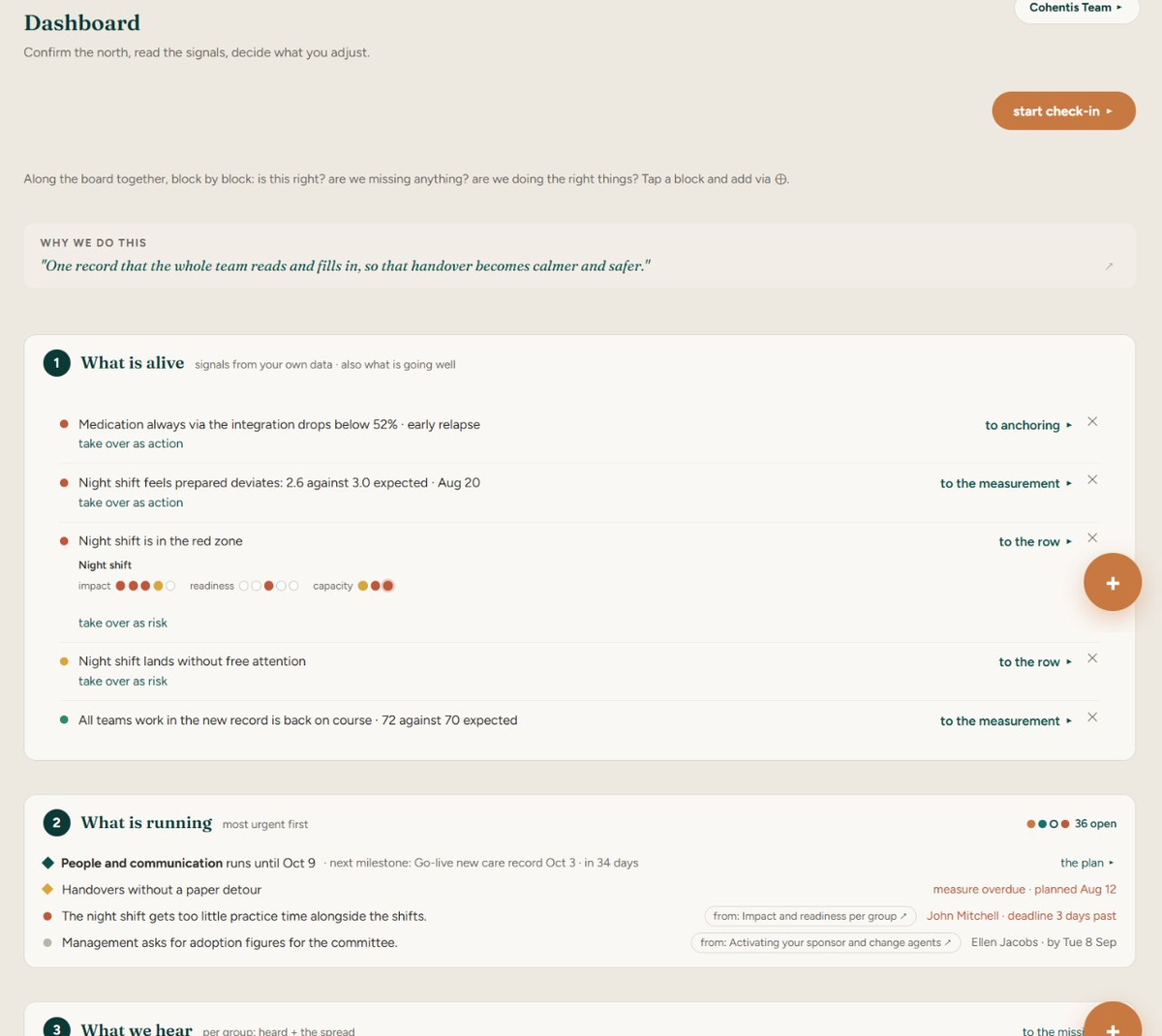
The Cohentis dashboard with the start check-in button and the numbered board blocks the session walks through Click to enlarge

What you're looking at

Top right sits the start check-in button: the session opens with a short round of the table. Under the shared why follow the numbered blocks: signals from your own data, the running work, what the field says. The session walks them in order, and every line carries a jump to the place where you act on it.

The dashboard is also the agenda of the weekly session.

Explore a sample project →
Numbers say what · conversations say why

Measure the change, and listen to it

A dashboard can tell you adoption is stalling. It can't tell you it's because night shift never got the training. Cohentis treats conversations as evidence: capture what people say, spot the pattern, and decide with both numbers and voices on the table.

01

Capture conversations

Log what you hear in two minutes. Who you spoke to stays private on your device. Only the pattern travels.

02

See what you're learning

Recurring themes, who you've heard from, and who you haven't. Blind spots show up before they turn into resistance.

03

Decide on evidence

Every insight links to the conversations behind it, the way evidence-based change management asks. When it gets hard, you decide on what was actually said, not on the loudest voice.

04

Revise the plan

What you heard updates your estimates, line by line. Every value you adopt keeps its source, so the plan moves with the field.

Try it in the sample project: open "the customer service merger" and see a listening mission in progress.

Explore a sample project →
Everything carries its origin

When someone asks why, the answer is already attached

Nothing in Cohentis stands alone. Every action knows which risk it answers, every insight knows which conversations it came from, every decision points to what prompted it. That's what a steering group trusts, and what a task list can't give you.

conversation insight ↗ risk ↗ action ↗ decision ↗

What Change plan costs

Free

Change plan

For the change manager running one change from vision to anchoring.

  • The compass: vision, success criteria, stakeholder map
  • A dashboard with a weekly rhythm: measurements, blind spots, risks
  • Conversations as evidence, everything carrying its origin
  • Planning with timeline, milestones and measurement points
  • Send out listening missions and review what comes back
  • Anchoring after go-live, and the snapshot for the portfolio

All prices →

Frequently asked questions

What is a change management tool?

A change management tool helps you plan, follow and adjust how people take on a change: who it touches, how ready they are, what you measure and what you hear. Change plan does that without an account, with everything on your own device.

How is Change plan different from a project tool?

A project tool tracks tasks and deliverables. Change plan tracks the people: which groups the change touches, whether they take it on, and what they say. It sits next to your project tool, not in place of it.

Do I need an account?

No. Change plan runs in your browser and your work stays in a file on your own device. Change agents work free too, without an account.

Does Change plan work with a change portfolio?

Yes. If your change runs inside a portfolio, your working file goes to Change portfolio, which takes a snapshot of it. What you measure comes back up to the benefit.
Open Change plan, free and without an account

Nothing to install, nothing to set up. You open the app and you work.