Evidence-based change management
Geert Barandat · updated 26 September 2026
Evidence-based change management steers on what you hear, not on what you assume. In organisational change management (OCM) you treat the target group not as one block, but as a distribution of subgroups that each need something different to come along. You gather what is really going on in each subgroup, and every value in your plan points to its source: the measurement, the conversation, the mission it came from.
What makes it evidence-based
Three things, in every part of your plan.
Every value points to its source. A readiness, a risk, an impact: you can show where it came from.
What you don't know stays visible. An open ring is an honest answer. Not a gap to fill with a guess.
Your estimate can be refuted. You write it down. The front line may prove you wrong.
The app shows and compares. You decide.
Why persuasion falls short
Most change initiatives steer on persuasion. You believe a group is ready, that a risk is minor, that the message has landed, and you plan on that. Until the target group tells the sponsor otherwise, and your credibility falls apart. Evidence-based work turns that around. You steer on what has been measured and heard, and when a stakeholder questions the change, you answer with the evidence, not with conviction.
That starts with how you view the target group. A group is not a block that comes along all at once. It is a distribution: a lead group out in front, a broad middle that follows once it feels safe, and a cautious group that is convinced last. Each subgroup moves at a different moment, for a different reason. And often what one subgroup needs depends on what the previous one already did: the middle comes along when it sees the lead group survived it.
Where this sits in evidence-based management
Evidence-based management, as the Center for Evidence-Based Management describes it, draws on four sources: research, organisational data, the expertise of practitioners and the concerns of the people affected. In change work, two of them are usually the weakest: organisational data and the voice of the people the change touches. What the organisation shows, and what the people in it say. That is where we work. Not instead of research or experience, but beside it, with a trail you can check.
Gathering what each subgroup needs
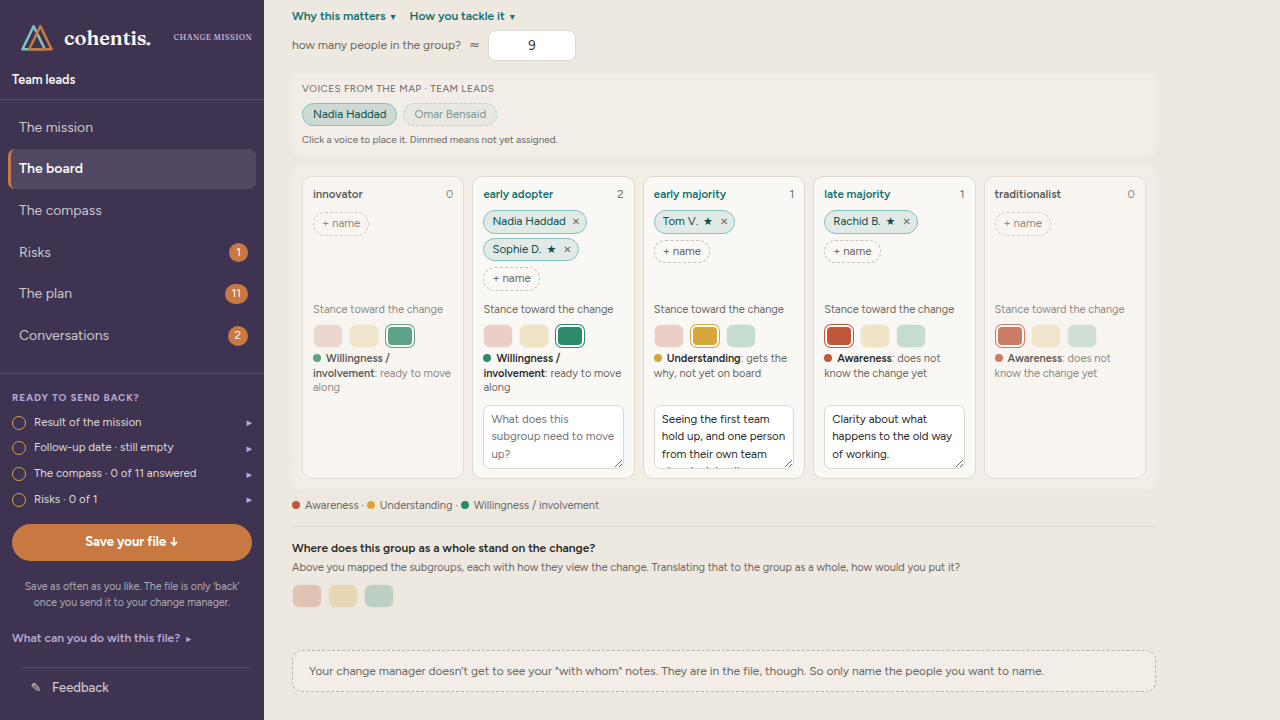
Evidence-based change management means you gather what each subgroup needs to come along, instead of assuming it. Not "the organisation is 60 per cent ready", but: what has this group heard, what holds them back, what would win them over. You collect that where it happens, on the front line, and you bring it back to your plan.
 Click to enlarge
The estimate, tested on the front line
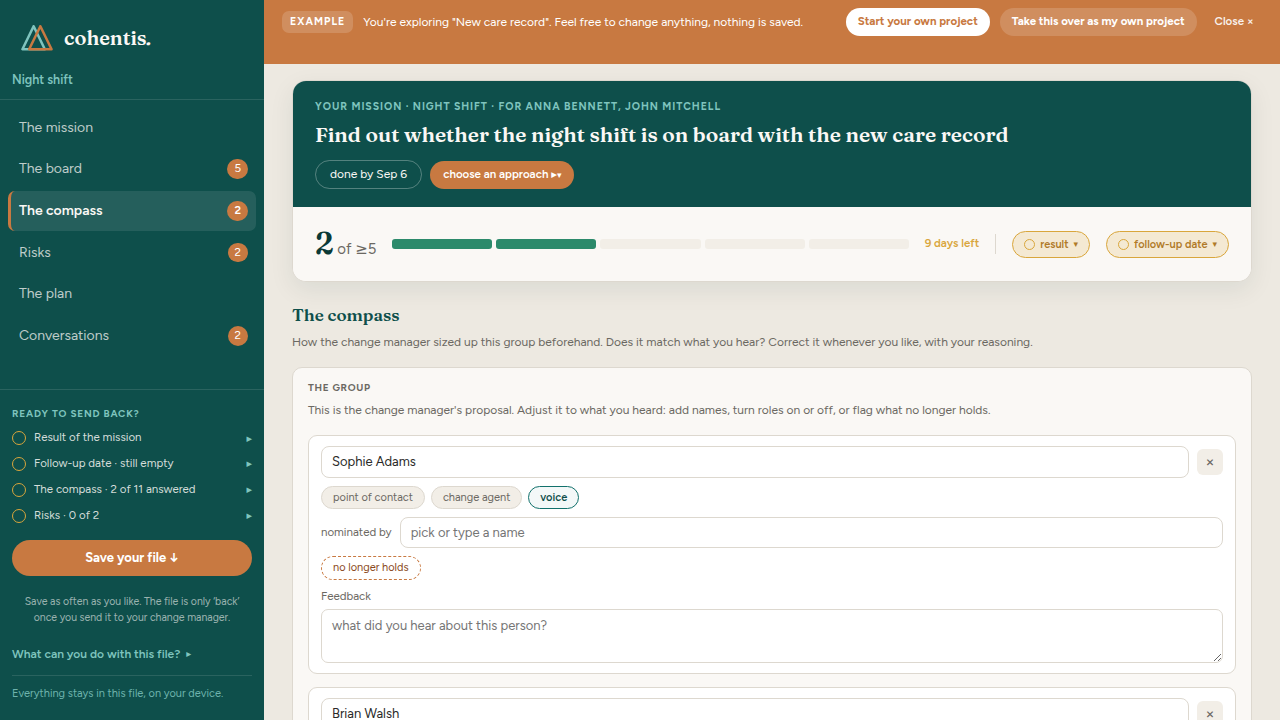
You start with an estimate. In the compass you record per group what you expect: the impact, the readiness, the capacity, the risks. That is your best estimate, based on what you know now. No more. An open ring means: not yet known. That estimate goes as a mission file to your change agent, with all the context. On the floor they test it: does it match what I hear? The agent confirms, corrects, or leaves it open when there is no information, each correction carrying a why. That way your assumption is not a settled fact, but something the floor may refute.
 Click to enlarge
Back, line by line
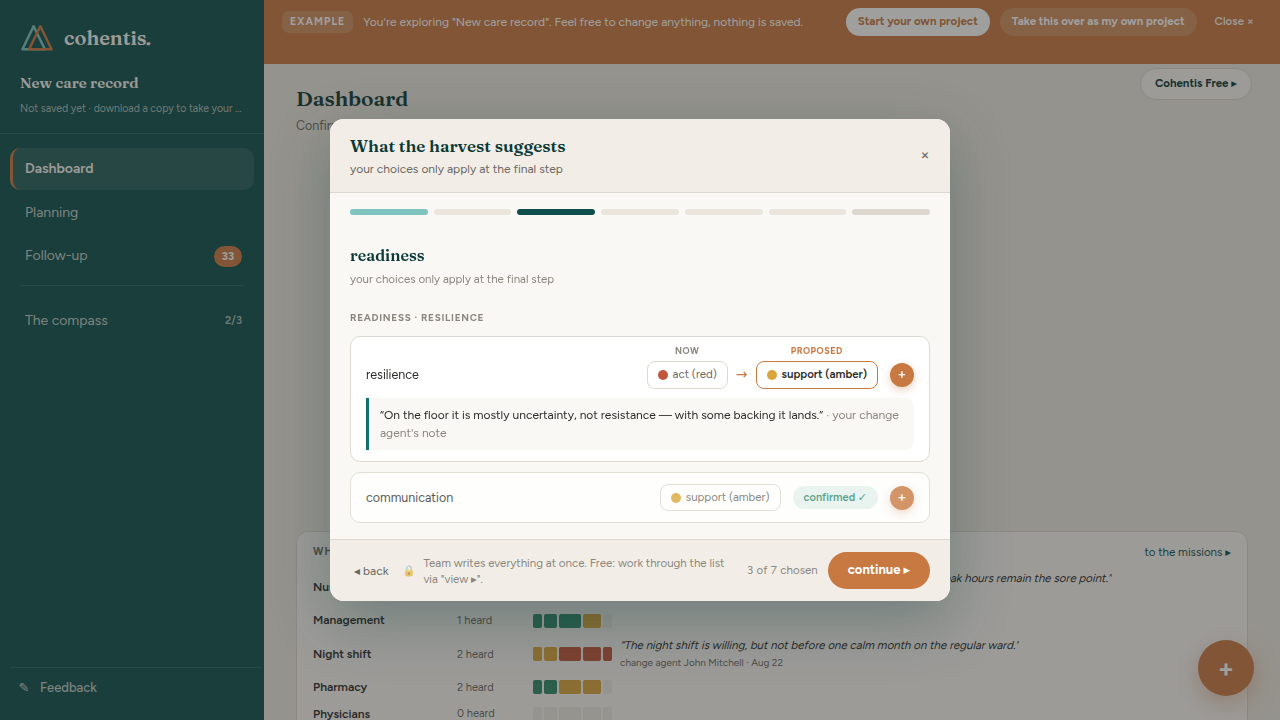
The mission file comes back to the change manager, with what the agents heard: the confirmations, the corrections, the conversations. On import the app sets two columns side by side, per layer: what is now in your change plan, and what the change agents discovered on their mission. That way you weigh line by line what should happen. You take the input into your plan, or you attach an action to it, a conversation, a risk or a note, to refine it further first. Import only adds, and never overwrites silently.
 Click to enlarge
Every value points to its source
What you take over carries its provenance. A readiness that went from red to amber points back to the mission, the agent and the conversation it came from. That way the difference between an estimate and a confirmation stays visible, and at any moment you can show where a value came from. That is what makes evidence-based concrete: not a feeling that things are improving, but a trail to the evidence.
 Click to enlarge
Where the evidence comes together: dashboard and stakeholder map
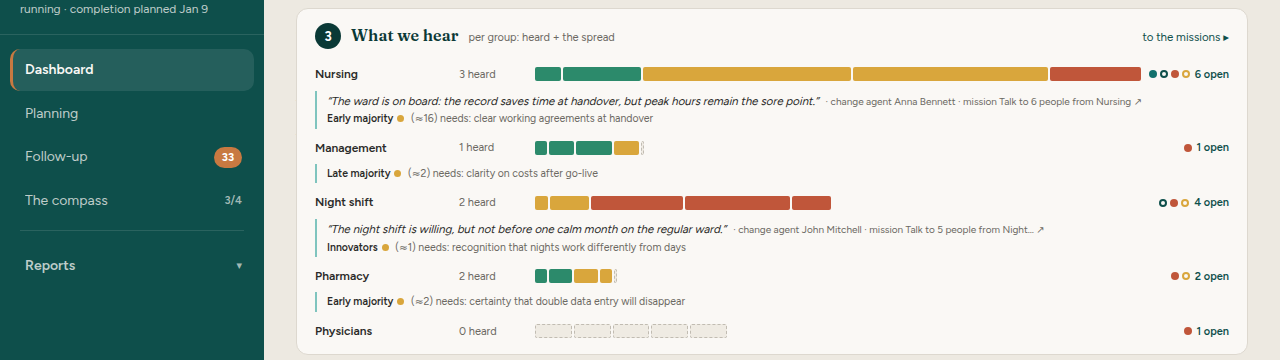
What you gather per subgroup comes together in two places. On your dashboard you see per group what has been heard and how it is spread: which subgroup already moves along, which does not yet. On the stakeholder map you see the state of each group, with the provenance from the mission harvest. If there is nothing, the app says so honestly. That way you steer on the distribution: you see where the movement already is and where a subgroup still needs something to come along.
 Click to enlarge
So evidence-based change management is not a separate report you draw up afterwards. It is how you steer: every value in your plan points to its source, what you do not know stays visible as not-known, and you decide with the evidence beside you. The app shows and compares, you choose. You can walk through the whole flow yourself in the sample project, without an account.
Up to the benefit
Evidence doesn't stop at adoption. A group can come along, and the expected benefit still fail to appear. In the change portfolio, the benefit map puts the chain side by side: initiative, outcome, benefit. For each benefit you see the reading at the start, now and at the end. The step from outcome to benefit stays an assumption. We show it. We don't calculate it away.
See the change portfolio →Common questions
What is evidence-based change management?
Evidence-based change management steers on what has been measured and heard, not on conviction. You treat the target group as a distribution of subgroups that each need something different to come along, and you gather what actually lives per subgroup. Every value in your plan points to its source: the measurement, the conversation or the mission it came from.
How does the evidence get into your change plan?
You start with an estimate per group in the compass. That goes as a mission file to a change agent, who tests it on the front line and confirms, corrects or leaves it open, each with a why. The file comes back, and on import the app sets what is now in your plan beside what the mission says. You choose line by line what to take over. Import only adds and never overwrites silently.
Why treat the target group as a distribution?
Because a group does not come along all at once. There is a lead group out in front, a broad middle that follows once it feels safe, and a cautious group that is convinced last. Each subgroup moves at a different moment and for a different reason, and often what one needs depends on what the previous one already did. By gathering what each subgroup needs, you steer on the distribution rather than on an average.
What sources does evidence-based change management use?
Evidence-based management draws on four sources: research, organisational data, practitioner expertise and the concerns of the people affected. Evidence-based change management strengthens the two that are usually weakest in change work: what the organisation shows, and what the people in it say.