Change portfolio management
Change portfolio management is keeping sight of every change running over one organisation at the same time: which groups are carrying how much, what collides next month, and what actually held from the one before.
Your plan is fine. The timing is the question.
You have your groups in view, your team is in place, you know what you are going to do. So do the two colleagues running a change of their own, and none of the three plans can see the other two.
–You cannot see who is already carrying something
A plan is built to look inward. It cannot know that the night shift is also absorbing a collective agreement round, or that the same first-line managers are the pivot in two other initiatives.
–It can land in their busiest month of the year
Your go-live date is a project decision. Whether December is the worst possible month for that one group is something no project instrument tells you.
–One after another, or all at once
Three changes in a row and the group is never out of change. Three at the same time and they stop absorbing any of them. For the organisation those were separate projects; for the people it was one long one.
Lay the plans next to one another and the question becomes answerable. The portfolio shows what is ahead and which teams and groups carry it, month by month, so you can choose when something lands instead of establishing afterwards that it collided.
One floor down, the other question: how do you keep a single change alive for nine months, with people who already have a job. That is what Change plan is for →
One plan cannot see saturation
A change plan is built to look inward. It knows its own groups, its own waves, its own go-live. What it cannot know is that the night shift is also absorbing a collective agreement round, that the same first-line managers are the pivot in two other initiatives, and that the team taking on a new care record in October is the team that moved office in July. For the organisation those were separate projects. For the people it was one continuous change with no end.
That gap is structural, not a reporting failure. No project instrument can see it, because each one is scoped to its own project. It only becomes visible when the plans are laid next to one another, and that is what a portfolio is for.
What the board says first
The dashboard opens with the three most heavily loaded groups over the next twelve months, then with what is open: initiatives without an impact picture, without a change manager, without a snapshot that came back. Nothing is coloured red for being behind. Every line counts facts and jumps to the place where you can act on it.
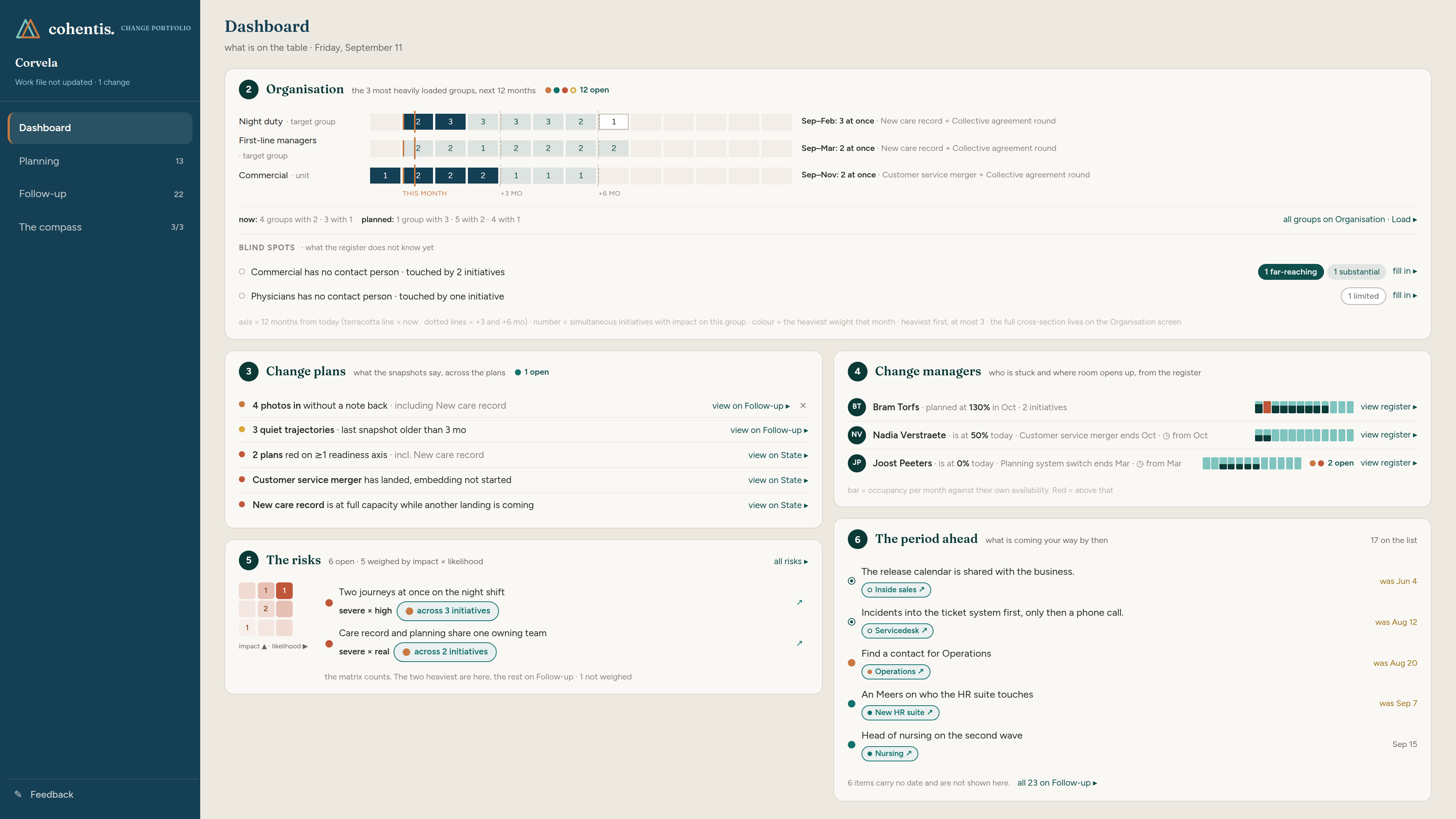 Click to enlarge
What each part of the organisation is carrying
The org chart is the organisation itself, with the weight of this month on each unit. A card carries the heaviest weight landing on it, the indicators you chose, and when that group was last spoken to. Where a unit has no contact person and is touched by two initiatives, it says so rather than leaving a quiet gap.
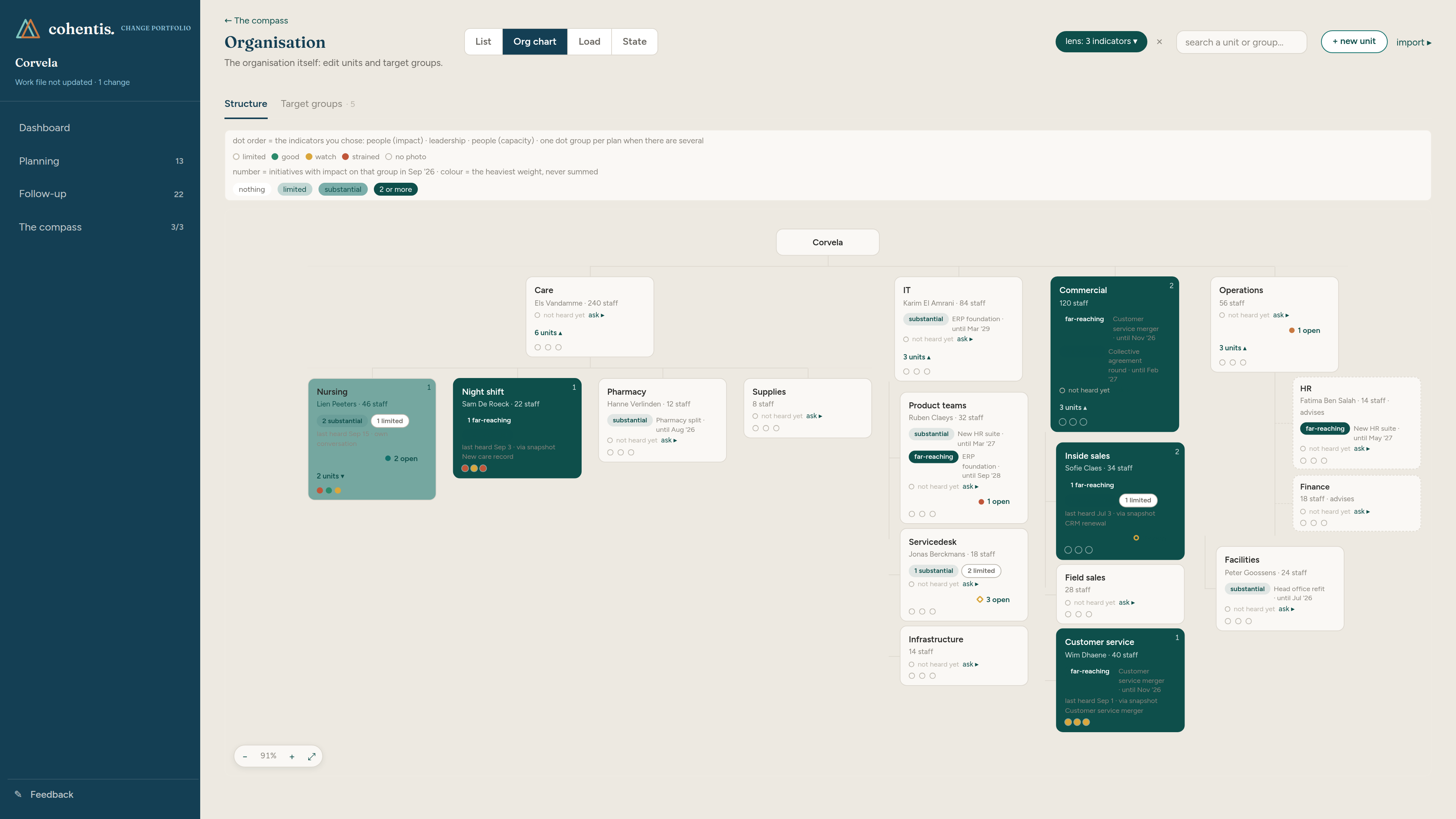 Click to enlarge
What is ahead, and when
The timeline holds every initiative, running and approved and still under consideration, with the status in the shape of the bar rather than in a colour that judges. Drag the cross-section line to a month and you see which groups are hit that month, with a counter where several initiatives land on the same one. There is no total and no colour sum: four light ones are not one far-reaching one, and that call belongs to the person looking.
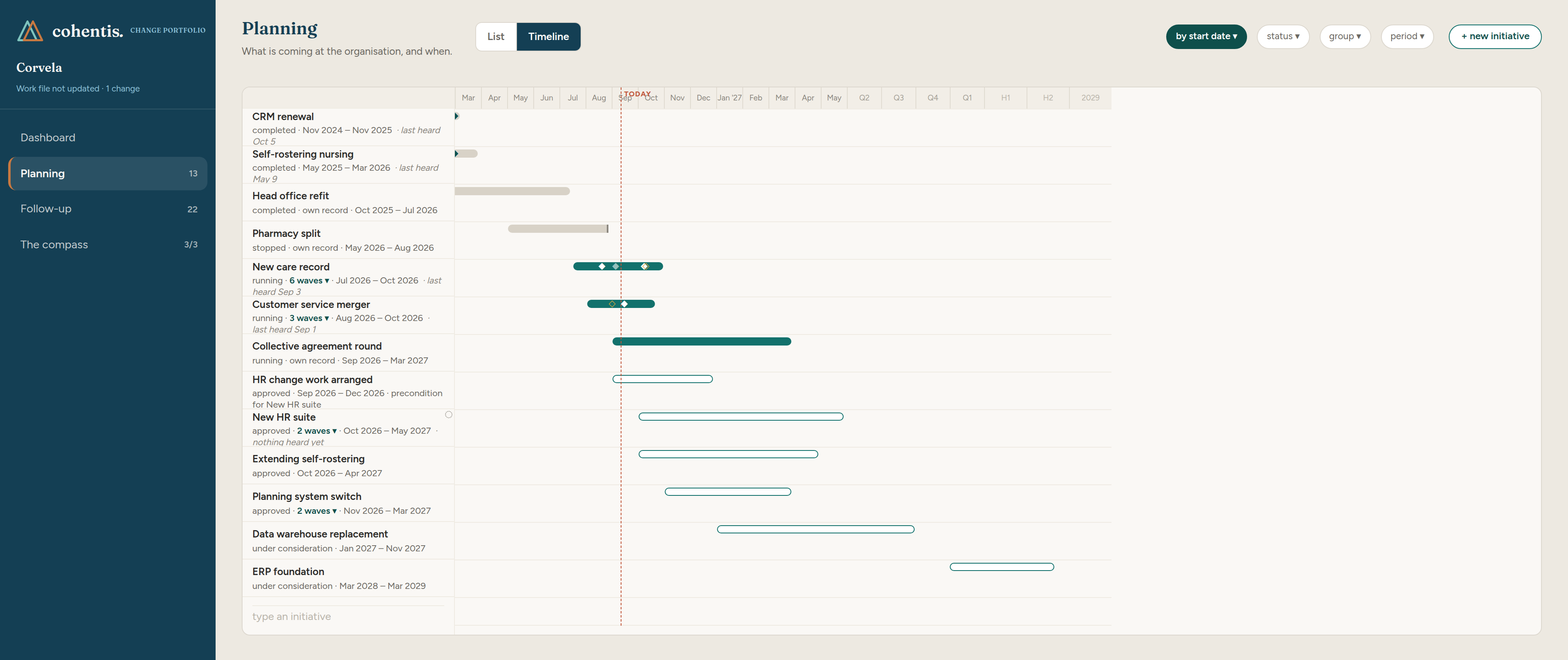 Click to enlarge
Sometimes the answer is no change manager
The heart of the role is not tracking, it is deciding what each initiative needs. The app shows the readings, behaviour change against what the environment can carry, and you make the call: a dedicated change manager, a coaching one, or the project lead on their own. Whoever sometimes says this one does not need guidance is believed when they say the next one does.
How it talks to Change plan
Upward, the change manager sends the work file and the portfolio derives its own snapshot from it. Downward, an environment note comes back that informs and does not instruct, and cannot write anything into the plan. Sideways, a mission file goes to the change agent and comes back filled in. There is one file type on purpose, because a second format would be a second truth within a month.
The first fill goes through your own AI
You fetch an instruction, paste it into your own AI together with your own org chart, and bring the answer back. That replaces the data-entry evening for an organisation of several hundred people. Two things hold: there is no AI inside Cohentis, and nothing lands without you confirming it line by line. An import only ever adds.
Common questions
What is change portfolio management?
Change portfolio management is keeping sight of every change running over one organisation at the same time: which groups are carrying how much, what collides, and what held from the previous one. It manages the capacity to change rather than a single change.
How is it different from project portfolio management?
A project portfolio tracks work, budget and delivery. A change portfolio tracks what lands on people: how much change one group absorbs at once, whether two initiatives hit the same group in the same month, and whether behaviour held after go-live.
Does the portfolio need a server or an account?
No. The portfolio is a file on your own device, like the change plan. Snapshots from running plans come in as files and are confirmed line by line.