How to make a stakeholder map
Geert Barandat · updated 26 September 2026
A stakeholder map is a living overview of every group your change touches, ordered by how hard the change hits them and how much say they have, so you know who to listen to first.
Start from impact, not hierarchy
Most stakeholder maps copy the org chart: sponsors on top, teams below. That tells you who signs off, not who changes. A useful map starts from the work. Which groups will do something different on Monday? A night shift that loses its handover ritual matters more to your change than a director who approves the budget and moves on.
You note groups, not names. "Planning team", "night shift", "team leads north". People rotate, groups persist. Ten to fifteen groups is normal for a mid-size change; more than twenty means you are mapping the whole company instead of the change.
Two questions per group
You place every group on two axes. Impact: how much does their daily work change? Influence: how much can they speed up or block the change? Four quadrants result, each with its own way of involving people. High-influence groups you involve early and closely, because they can carry the change or hold it back. High-impact, low-influence groups mainly need something else: a voice, and the sense that they are heard. It is often that group that gets less attention, while it is exactly where the quietest resistance builds. It is worth pausing there on purpose.
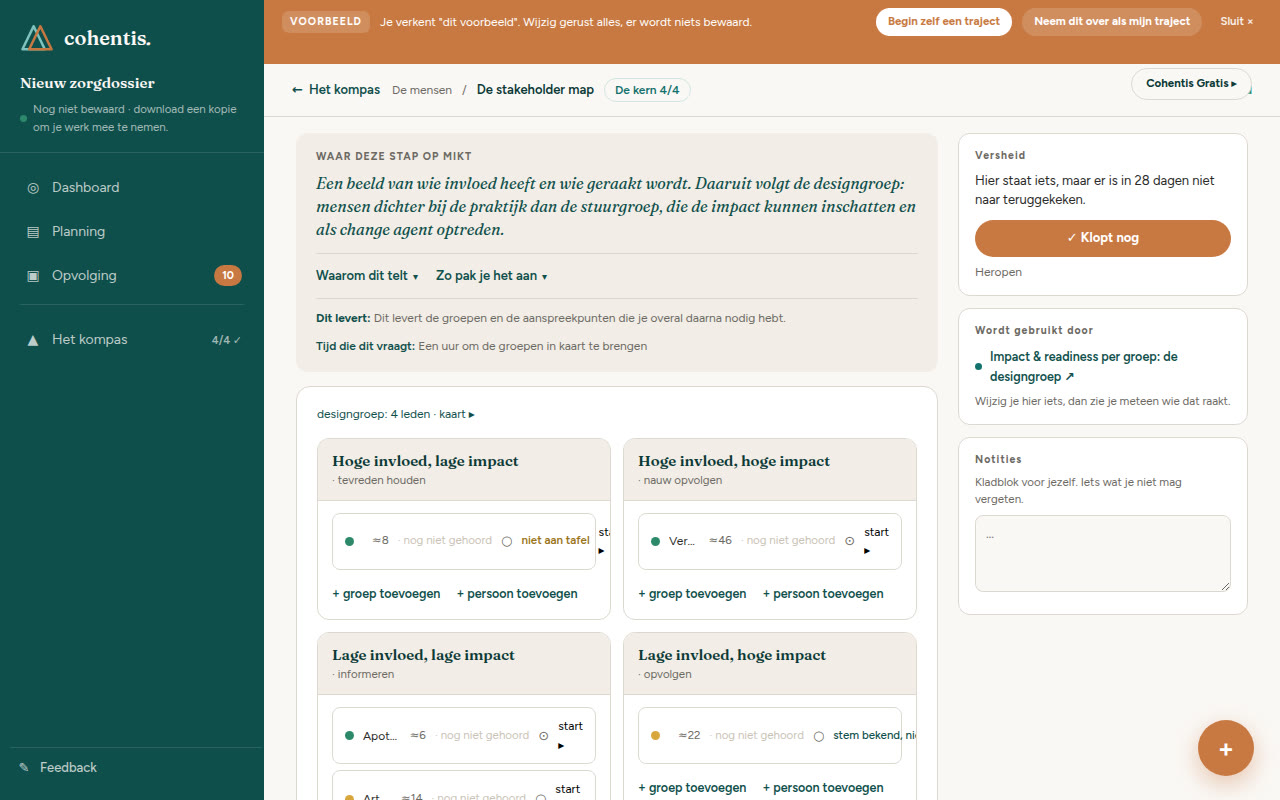 Click to enlarge
Keep it alive
A stakeholder map made once, in a kickoff workshop, is a photograph. Groups move: a team that was neutral in March is blocked in June because the workload landed on them. The map only earns its place if every conversation and every signal you pick up can move a group, and if you can see, at a glance, who you have not heard from lately.
In Cohentis, the map listens with you
From every group or person on the map you start concrete work right away: a conversation to have, an action to take, a mission to find something out, or a risk to keep an eye on. What you link stays attached to that group, with where it came from. Your follow-up holds it all together, and your dashboard taps you on the shoulder when something needs attention, a deadline is near, or a group has been quiet too long. That way you keep continuous sight of what is going on and what is becoming important, instead of a map that goes quiet after the kickoff.
Common questions
What is a stakeholder map?
A stakeholder map is a living overview of every group your change touches, ordered by how hard the change hits them and how much influence they hold, so you know who to listen to first.
Do you put groups or people on a stakeholder map?
You start with groups, because people rotate and groups persist. Ten to fifteen groups is normal for a mid-size change. Per group you can then name the people you need, each with their role.
How do you keep a stakeholder map up to date?
A map made once, in a kickoff, is a photograph. It only stays right if every conversation and every signal can move a group, and if you can see at a glance who you have not heard from lately.