How to work with resistance to change
Geert Barandat · updated 26 September 2026
Resistance to change is what people do when a change costs them something they value, and they don't yet see what it gives back. It is information about the change, not a flaw in the people.
Resistance is information
A remark in a corridor. The same objection for the third time. A team that agrees in the meeting and then works the old way. It is tempting to see that as a problem with people. It is more useful to read it as information about the change.
Resistance usually has one of three causes. The plan has a real flaw, and the people who do the work see it first. The change costs them something they value, and nobody has named that loss. Or they have simply not been heard. Each cause asks for a different answer, and persuasion answers none of them.
The quiet kind is the one you miss
Loud resistance is easy to see. Quiet resistance is not. It looks like agreement, followed by nothing. A new tool that is opened but not used. A workaround that grows in a drawer. Silence from a group that usually speaks up. It often builds in the groups the change hits hard but who have little say. So the useful question is not who is against it. It is who you have not heard from lately.
 Click to enlarge
Not everyone resists at the same moment
A group moves as a distribution, from innovators to traditionalists. Traditionalists are not the resisters. They wait, and usually for a reason. Resistance often shows up somewhere else: in the early majority, when it sees the early adopters struggle. So per subgroup, ask what it needs from the one before it. That tells you more than a count of who is for or against.
Resistance or change fatigue?
Not every no is about this change. Sometimes a team says no because it is carrying four changes at once, and yours is the fourth. That is change fatigue. It looks like resistance, but a better argument does not help. What helps is sequencing: less at the same time, or more support while it lasts. That is a question for whoever sees all the changes together, not only yours.
Answer the cause, not the behaviour
When the plan has a flaw, change the plan, and say that you did. Few things build trust faster. When the change costs something, name the loss. People accept a loss more easily than a denial of it. When a group has not been heard, go and listen, or send someone who belongs there.
And when resistance hardens into conflict between people, it needs a different craft. That is mediation, not change management.
In Cohentis, resistance shows up before go-live
 Click to enlarge
You capture a conversation in two minutes. Start it from the group it is about, and it lands there. On the stakeholder map you see at once which group you have not spoken with yet, and the dashboard shows it as a blind spot. That is where quiet resistance starts.
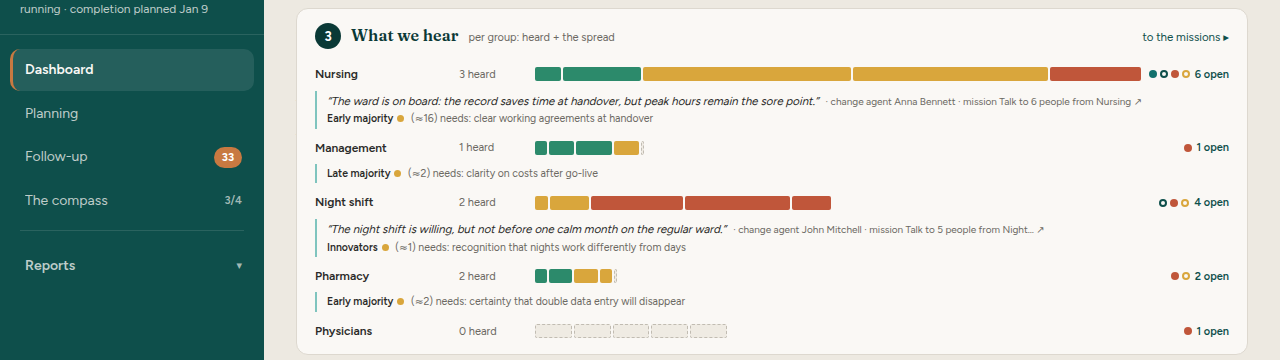
Open a group and what you heard comes together: the pattern, how widely it is shared, how many conversations it rests on, and what each subgroup needs. Buy-in you set yourself, per group and per person: strong, fragile, or resistance. The app infers nothing.
When a signal on the dashboard speaks to you, one click takes it over as an action, a risk or a conversation, with its origin attached. And a mission sends a change agent to the group, to find out what each subgroup needs to move up. So you answer what you heard, not what you assumed.
Common questions
What is resistance to change?
Resistance to change is what people do when a change costs them something they value, and they don't yet see what it gives back. It is information about the change, not a flaw in the people.
What causes resistance to change?
Usually one of three things: the plan has a real flaw, the change costs people something nobody has named, or they have not been heard. Each cause asks for a different answer.
What is the difference between resistance and change fatigue?
Resistance is about this change. Change fatigue is about the total: a group carrying too many changes at once. Fatigue is not solved with a better argument, but with sequencing or more support.
What is passive resistance?
Resistance that looks like agreement. People say yes in the meeting and keep working the old way. It often builds in groups the change hits hard but who have little say, which is why it pays to track who you have not heard from.