You received a mission file
Geert Barandat · updated 26 September 2026
A colleague who leads a change has asked you to listen to one group. The mission file holds what they know so far and the questions they want answered. You need no account and no licence.
What a mission is
A mission is a short listening assignment. It names one group, a goal and a few open questions. You go out, you listen, and you bring back what you heard. That's all.
You are not asked to convince anyone. You are asked to find out how the change is landing, in a group you know better than the person who sent you.
Is it safe to open?
The mission file is a small file, like a document. It opens in the Cohentis app, in your browser, also on a phone. There is no account to create, and what you write stays on your device until you send the file back yourself. The app only keeps anonymous usage counts, never content.
What you do
Open the file. You see the context: where the group stands, what is planned, which risks the change manager sees.
Listen. Have the conversations the mission asks for. During or after each one, you note what people said.
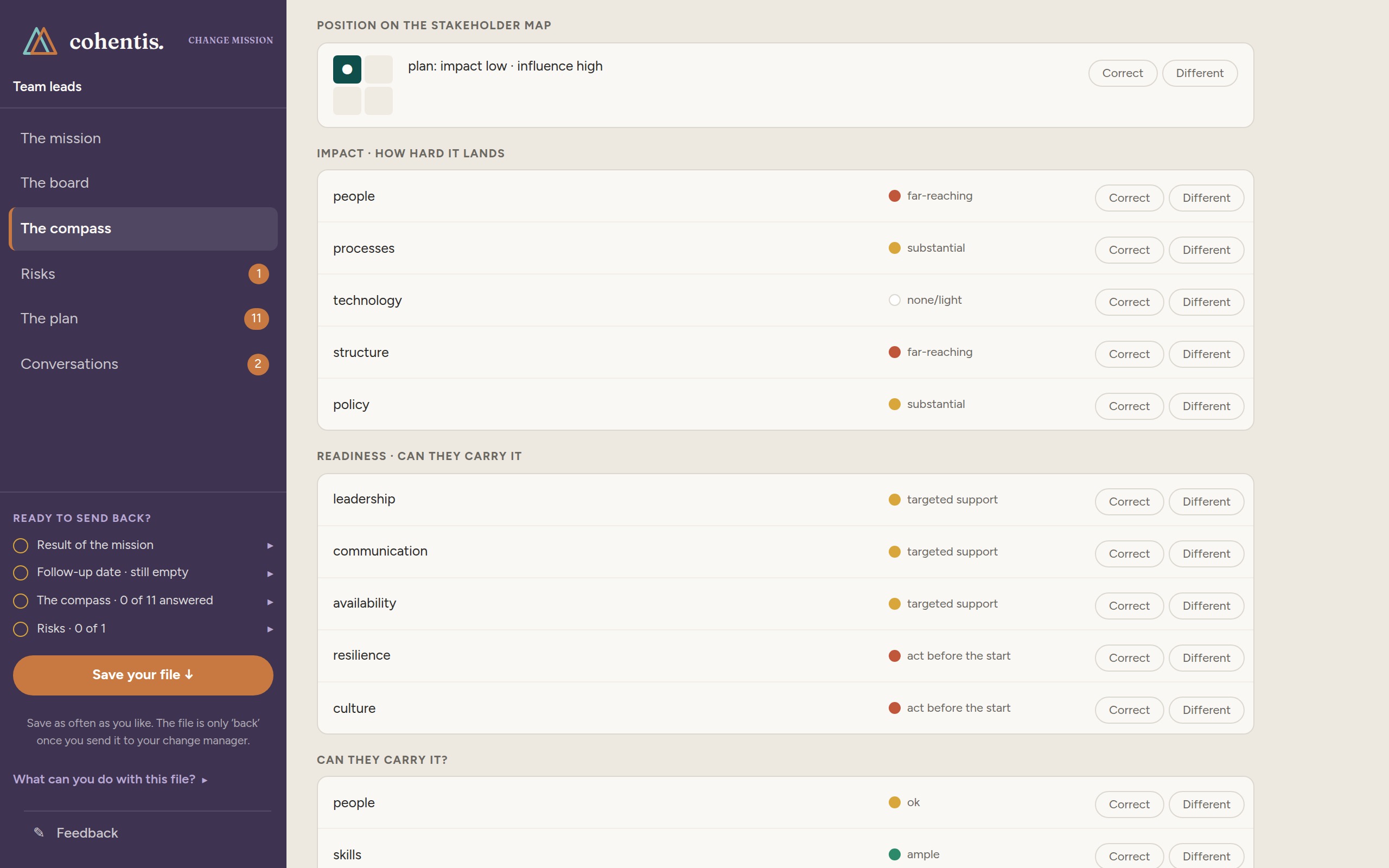
Check the estimate. The change manager wrote down what they expect for this group, line by line. You confirm a line with Correct, or choose Different and say what you see and hear. When you don't know, you leave the line as it is. Not known is an honest answer.
 Click to enlarge
Send it back. You return the file to the change manager, the same way you received it.
Listening, not convincing
How you listen is up to you. Use the method you know, ADKAR or another: a one-to-one, a group conversation, a morning alongside the team. The mission file does not steer your approach. It holds the data: what you heard, in which subgroup, and what that subgroup needs.
Ask open questions. Write down what you hear, also what you didn't expect, and also what goes against the plan. That is often the most useful part. A mission that only brings back good news has not been heard.
Not everyone moves at the same moment
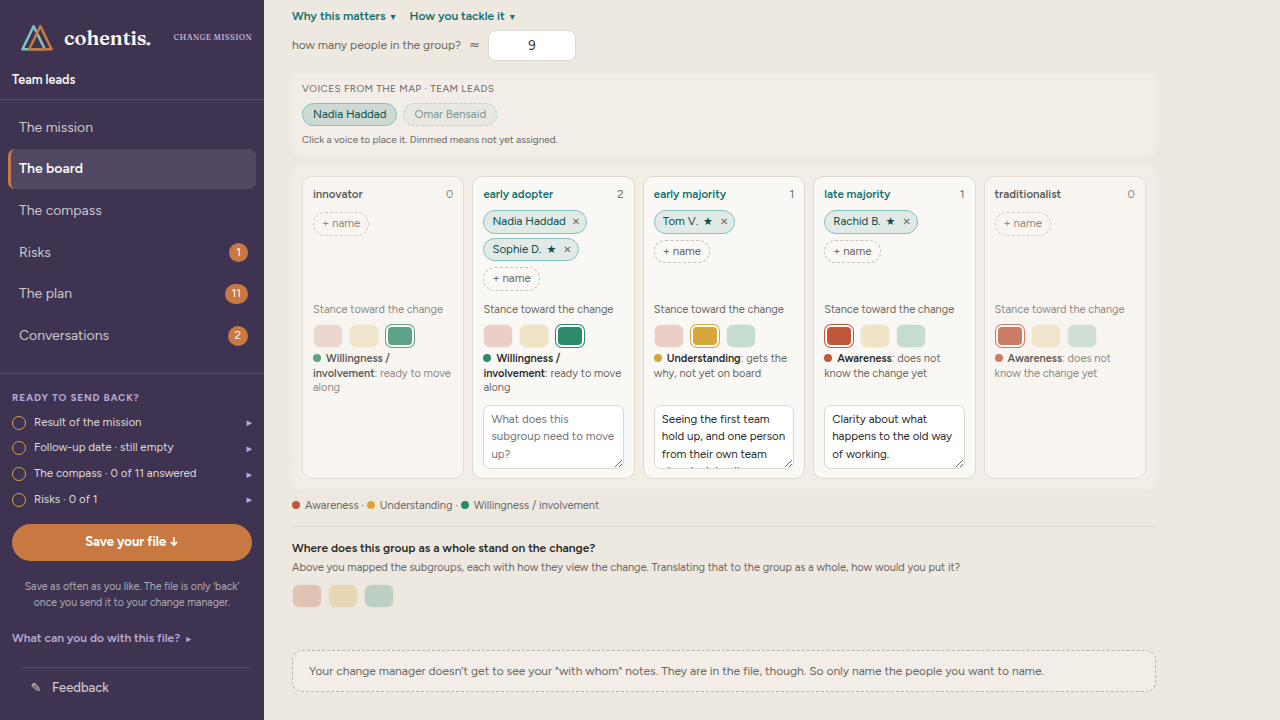
A group does not change all at once. It moves as a distribution. A few innovators try it before anyone asks. The early adopters follow once they see it can work. Then the early majority, the late majority, and last the traditionalists, who want to be sure before they move. On the board in your mission file you place the people you hear in those five subgroups. Each subgroup gets its stance toward the change.
 Click to enlarge
Ask where each person stands, and where they see themselves. Someone may call themselves an early adopter while the team sees it differently. Both are worth writing down.
The innovators are an opportunity. They can be the voice of the group, or the next change agent. Mark them with a star, and they go back to the stakeholder map as a credible voice.
Each subgroup also needs something from the one before it. What do the early adopters need from the innovators? What does the early majority need to see from the early adopters? For every subgroup the board asks what it needs to move up. That answer often tells the change manager more than a score.
Traditionalist is not a verdict. It is a moment. People who wait usually have a reason, and that reason is information the plan needs.
What happens with it
The change manager reads what you brought back next to their own plan, line by line, and decides what to take over. What they take over keeps its source: your mission and your conversations. So your input is not lost in an average. It is visible as yours. What you place on the board comes back too. On the stakeholder map the change manager then sees where the group stands: how it is spread, and where the movement is. Who you spoke with travels along in the file, so a later mission to the same group can build on it. The change manager's app does not show those names, but they are in the file. So you decide whether to name someone. Whoever names someone does so for a reason, and stands by it. If you'd rather not, write it without a name.
What the mission file looks like
 Click to enlarge
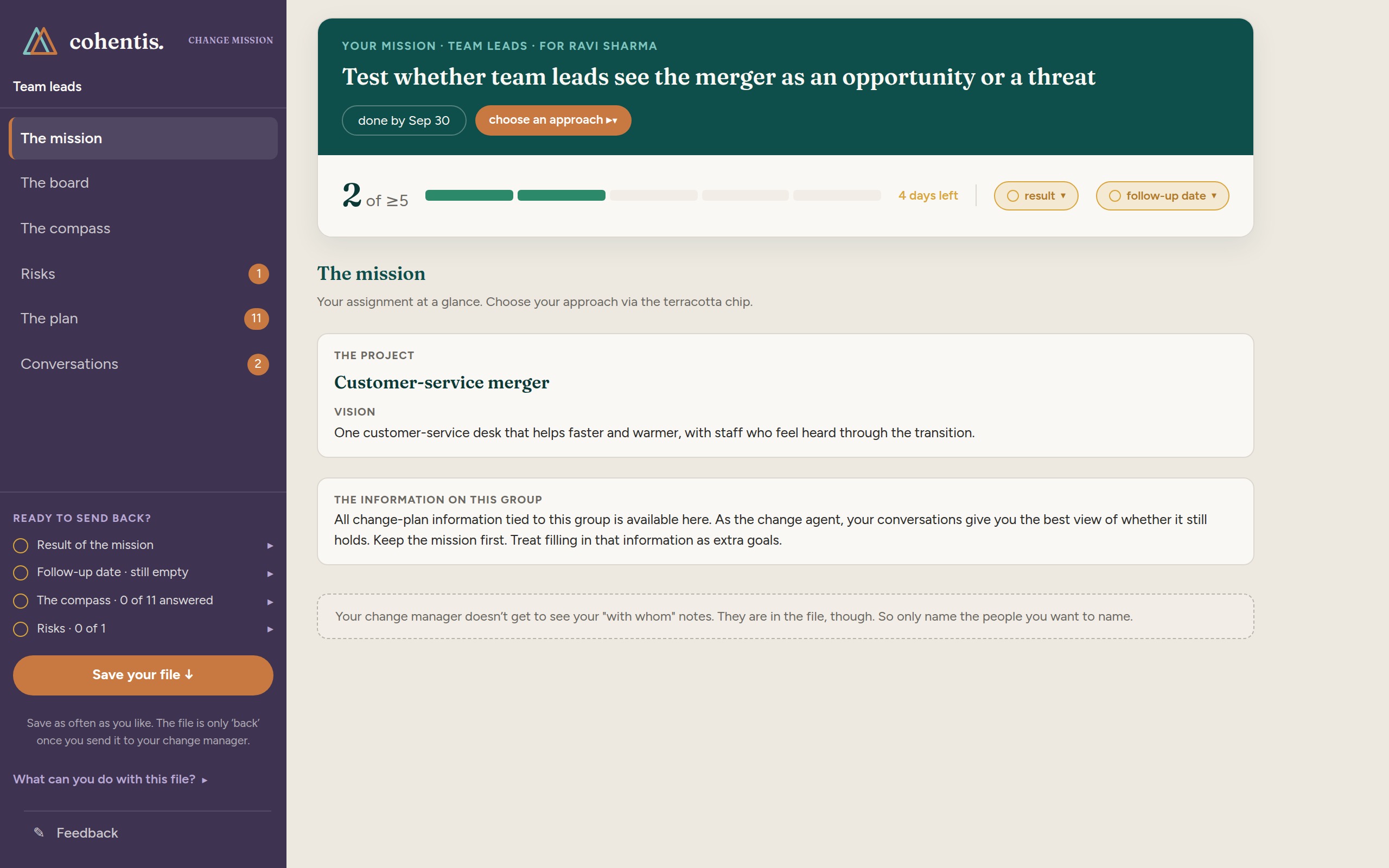
The file reads like a document, not a form. It opens on your mission: the group, the goal and the deadline, and what is already known about this group. From there you reach the compass, the risks, the planning and your conversations.
You note what you hear per person, on a laptop or a phone. Save as often as you like. The file only counts as returned when you send it to your change manager.
Common questions
What is a mission file?
A small file from a change manager, asking you to listen to one group. It holds the context, a goal and open questions. You fill it in and send it back.
Do I need an account or a licence to open a mission file?
No. The mission file opens in the Cohentis app without an account and without a licence, also on a phone.
Is what I write sent anywhere?
No. What you write stays on your device, and only leaves when you send the file back to the change manager yourself. The app counts anonymous usage, never content.
Do I have to follow a particular change method?
No. You use the approach you know, ADKAR or another. Cohentis does not steer on approach, only on data: what you heard, and where the group stands.
Why does the mission split the group into five subgroups?
Because not everyone in a group changes at the same moment. Innovators, early adopters, early majority, late majority and traditionalists each need something different to move, and often something from the subgroup before them.
What if I don't know the answer to a question?
Leave it open. Not known is an honest answer, and the change manager sees it as not known rather than as a guess.