Creating a shared vision in change
The theory of a shared vision is everywhere. How you actually get there with your steering committee, far less. This is the way it works in organizational change (OCM): from a sharp starting point, through each participant's interests, to a shared need, the shared why that everyone carries.
Why a supported vision takes work
Confusion in change often arises on the shop floor, when employees each hear the story of a different leader and, when they talk to each other, find little overlap. I heard this, but I heard that. The cause lies higher up: the steering committee had no shared core to start from. The good news is that you can build that core, with an approach that fits in one or two workshops.
Making everyone say the same thing does not work. Employees sense a rehearsed uniform story immediately, and it takes away each leader's chance to make the change credible in their own words. What you need is a shared core with room for an own story. Below is how you get there, step by step.
Step 1 · Sharpen the starting point
Before the workshop you fix the starting point, together with your sponsor. Four questions: why do we do this project? What do we see happening if we do not? Which actions do we propose to avoid that negative impact? And why does this matter to our organisation? This is the sharp formulation of the change, in Cohentis the first module of the core. It is the foundation the rest rests on. Here you also decide who is in your core team, the steering committee that carries the why and the direction. They give the first input for your stakeholder map right away: which groups does this change touch, and who do you need at the table.
 Click to enlarge
Step 2 · From individual interests to a shared need
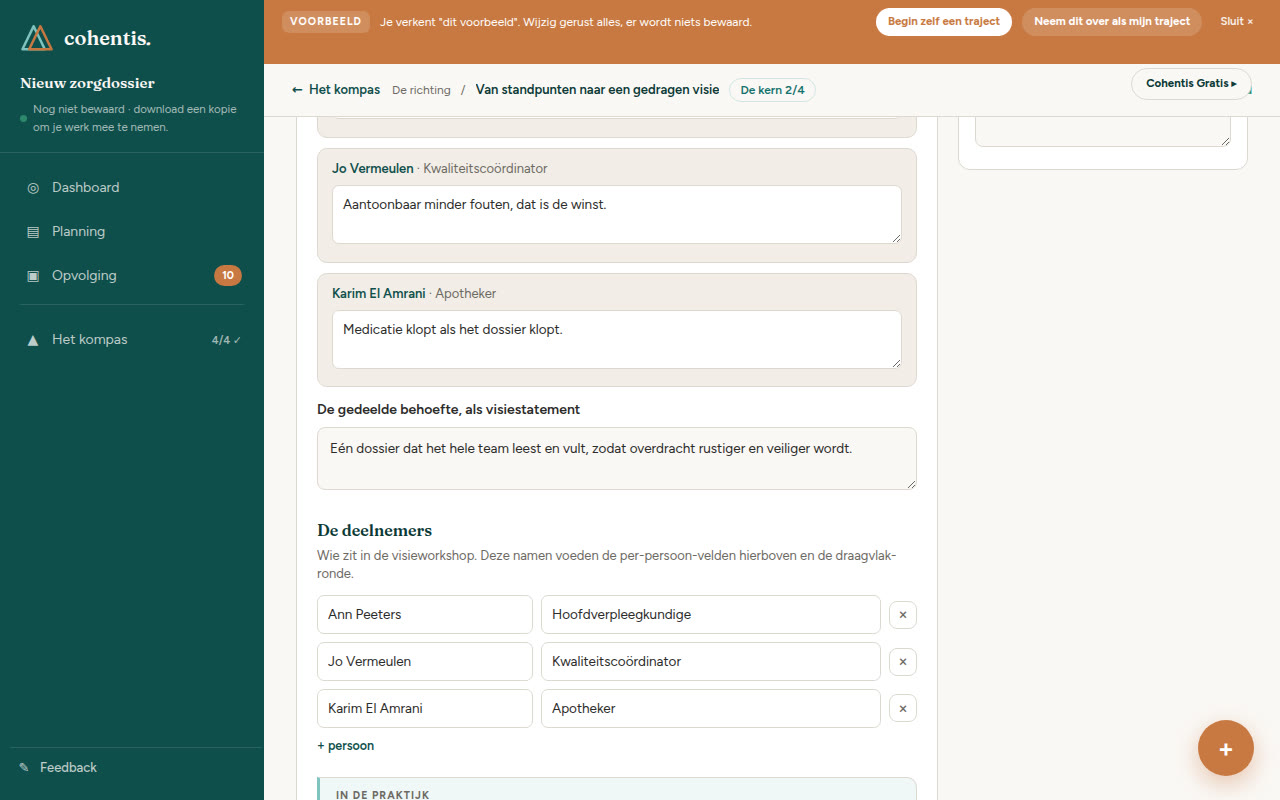
This is the workshop, and the heart of the approach. With the steering committee you explore what the project means to each participant individually. IT wants to deliver faster. Finance wants to cut the cost of IT projects. HR wants a stronger employer brand. Those interests differ, and it is exactly those nuances you want on the table. Important: participants need to hear this from each other, because that is where understanding grows. Then together you find the shared need, the interests this project fulfils for everyone. That becomes the core of your vision statement, which participants carry along with what matters to their own department. This is how an authentic message with a clear shared core arises. And from that authenticity, employees also hear what it means in their context, and why it matters. In Cohentis this is the second module, where you capture the vision statement under the shared need.
Step 3 · From vision to measurable success criteria
Finally you make the vision measurable, in the same workshop or separately. What does success look like? When can we say this project is done? What do we want to achieve? Here ownership is crucial. You manage the overview as change manager, but ideally participants take ownership of the metrics they set themselves. With each owner you find interim measurement points that allow steering, and you note them on the planning. After each measurement you fill in the result at that point. That way you get sight of the evolution across periods, and a picture of how the change is landing. In Cohentis this is the third module, and these measurement points form the north on your dashboard.
And then: from direction to realisation
With these three steps your steering committee has set the why and the direction. But you do not realise a why with the steering committee alone. Your stakeholder map points to who forms your change design group: people who represent their constituency, stand closer to practice, and want to act as change agents. It is with that design group that you review and adjust the dashboard periodically, to reach the metrics and deliver the why. This is how the four steps connect, from setting direction to realising it together. You can read that full story on the change management approach page.
In Cohentis your vision sits at the top of the dashboard
The three modules of the core interlock. In the first you sharpen the change. In the second you capture your vision statement under the shared need, the shared why that grew from your steering committee's interests. In the third you set the measurable criteria. On your dashboard it comes together: the vision statement sits right at the top, above the north, where your change team rereads it in every moment of doubt. Below it, in the north, are the success criteria from the third module: the measurement points you steer towards. That way your vision is not a document that falls quiet, but the first line everyone sees, with the figures below that show how the change is landing.